The Verge: Google may add Windows 10 dual-boot option to Chromebooks.
https://www.theverge.com/2018/8/13/17682902/google-windows-10-dual-boot-chromebooks-support-campfire
The Verge: Google may add Windows 10 dual-boot option to Chromebooks.
https://www.theverge.com/2018/8/13/17682902/google-windows-10-dual-boot-chromebooks-support-campfire
Android Police: Google posts new Duplex demo to show how Assistant will identify itself on the phone.
https://www.androidpolice.com/2018/06/27/google-posts-new-duplex-demoq-show-assistant-will-identify-phone/
Boing Boing: Garbage In, Garbage Out: machine learning has not repealed the iron law of computer science.
https://boingboing.net/2018/05/29/gigo-gigo-gigo.html
Shared via Google News
‘Atlas’ 4K Chromebook may be one of the first Chrome OS ‘detachables’ http://google.com/newsstand/s/CBIwjuqUjzg
This is the sixth and final post in this series about how to identify entities in data sources that can readily be classified as belonging to each of the 6BI Business Object Categories (BOCs): Parties, Things, Activities, Locations, Events and Motivators. The fifth post in the series (about Events, the “When” aspect) can be found at https://birkdalecomputing.com/2018/01/30/identifying-events-when/ .
The Motivators BOC is probably the most nuanced and least understood BOC. I have earlier devoted an entire article about the meta-data structure of motivators entitled “The Data Architecture of Business Plans”[i] which can be found at https://birkdalecomputing.com/6bi-home/the-data-architecture-of-business-plans/ .
The Motivators BOC identifies Why things get produced and consumed by parties. Concepts and objects in this BOC capture data about the ends, means, influencers and assessments that provide the reasons why parties exchanged things (products and money) at a particular time and place. Ends and means are in general too abstract to be found in object names, but you will find names such as Strength, Weakness, Opportunity, Threat, and Key Performance Indicator (KPI) all of which are assessment elements.
Data element and data element collection names you may encounter that belong to the Motivators BOC include, but are not limited to, names in the following table[ii]. The list gives you a hint of what kind of names to look for in putting together a 6BI Analytic Schema for enabling your data to answer business questions.

In terms of identifying motivator data elements (i.e. attributes and columns) and motivator data element collections (i.e. entity types and tables) the most likely candidates are documents, or at least those objects that have the word Document in their name. You need to consider documents, because it is quite often that you will find the means (missions and courses of action) of an enterprise described in document form, especially if the document name contains words such as Strategy/Strategic, Tactic, Enablement/Enabled, Directive, Policy or Rule. The ends of an enterprise (visions and desired results) can also be described in a document, quite often having a name like Goal or Objective.
As mentioned in the post about the Things BOC[iii], a document can also be considered a type of thing, such as a definition. As in “the definition” is being assessed for accuracy, for example. However, if its purpose is to contain text that describes means or ends it also belongs to the Motivators BOC. An event can also be a motivator such as Appeal and Campaign. But as was mentioned in the Events BOC, events are primarily differentiated from other concepts and objects by their inclusion of a time data element, either a point in time or a duration.
Another source of motivators is reference data. Reference data can describe business functions (see the post on the Activities BOC) and often determines choices that users make on user interfaces which then determine logic paths that an application will take when processing data and thus explain why certain results are derived. Example data element and data element collection names that often become the basis of reference data management (RDM) include: Code, Type, Tag, Status and Class/Classification. Often you may find these name in plural form as well.
So, if you are analyzing a legacy database and you come across a table with any of these words in its name you need to study the content of the table and understand how the rows and columns of the table effect, or are designed to effect, the motivation for actions taken by the parties in the organization.
The Motivators BOC is especially relevant to the type of NOSQL database known as a document database, Mongo DB being a prime example. It is one thing to structure and access the data in a document store in an effective and efficient manner but, in terms of answering business questions, it is even more important to know what role the content of the document plays in the operation of the enterprise. In other words, how does or how should the document provide the answer to “why” a business transaction took place between parties.
Another category of motivators deals with security and privacy, and sometimes is included in policies and procedures. Names here include Authorization, Enforcement and Permission, among others. The intersection between business motivation and security is ripe for further exploration.
This is the last post in this series. I hope you will find them worthwhile and useful. To find each one just click the link in the first paragraph of each to take you to the previous one. The first in the series about the Parties BOC can be found at https://birkdalecomputing.com/2017/04/26/identifying-parties/ .
Thanks for reading them and best of luck in developing your 6BI Analytic Schemas.
[i] The title “The Data Architecture of Business Plans” is derived from the fact that Business Plans are the deliverable of the Motivation aspect (the “Why” interrogative) at the Business Management, or Conceptual perspective of the Zachman Framework for Enterprise Architecture.
[ii] As previously, I would like to thank Barry Williams and his excellent Database Answers website http://www.databaseanswers.org/data_models/ for providing many of the table name examples.
[iii] https://birkdalecomputing.com/2017/05/04/identifying-things/
This is the fifth in a series of posts about how to identify entities in data sources that can readily be classified as belonging to each of the 6BI Business Object Categories (BOCs): Parties, Things, Activities, Locations, Events and Motivators. Entity types in the Events BOC identify When production and consumption of things by parties occurs. The fourth post in the series (on Locations, the “Where” aspect) can be found at https://birkdalecomputing.com/2017/08/23/identifying-locations/ .
Concepts and objects in this BOC capture data about a point in time or the duration of time over which products or payments flow from one party to another, or when an enterprise carries out its work. Data element and data element collection names you may encounter that belong to the Events BOC include, but are not limited to, names in the following table[i]. The list gives you a hint of what kind of names to look for in putting together a 6BI Analytic Schema for enabling your data to answer business questions.
Events break down into two major sub-types: (1) Occurrence types, which include Event, Alert, Notification, and Incident from the list above; and (2) Duration types which include, Year, Month, Week, Day, Hour, Minute, Second, Date and Time from the list. Duration type entities, as no doubt is obvious, are units of time and can be used to aggregate facts in a star schema across a temporal hierarchy. Occurrence types are more like things. Instead of being produced and consumed, they occur, that is they are something that can be referred back to that, in addition to any other properties they may have, always have an aspect of time or “when” about them, this aspect is important for data analysis.
Unlike the other BOCs, the Events BOC has both dimensional and fact characteristics. On the one hand, time is already defined into a hierarchy and is standard for everyone. An hour is always an hour, sixty minutes, a minute is always a minute, sixty seconds, and so on. On the other hand event occurrences are things that happen and can be measured and compared. They are data, not metadata as the hierarchy of time is. Events happen and then they are over but there can be much to learn from their having occurred. This BOC is conceived to capture important data about the perspectives of when something happens in your data. These perspectives relate to when, not where, not who, not how, not why, not even what has happened, but when it happened, or will happen.
This BOC captures the characteristics of time that most influence results. It is also important to understand how events differ from either locations or activities, two other previously covered BOCs, with which events are often confused.
A location is concrete. It is a point in space, a place, even if that space is virtual. You can go away and come back to a location, and if most (not necessarily all) other factors are the same, or within tolerances, the location is still there. Not so with an event. An event, though all relevant data may be captured about it, once it occurs, is done and goes away forever. Another instance of a particular class of events can subsequently occur, but each event is unique and has a time when it occurred.
Events and activities are closely related and co-dependent but are not the same. Activities are event-driven. They receive and react to events and create new events which are sent to other activities. Each activity is an independent entity and can execute in parallel with other activities. Coordination and synchronization is by means of events communicated between the activities. Activities react to input events by changing state and creating output events[ii].
The important thing, from a 6BI perspective is that an event provides a temporal association for a result. If the persons, places, products, locations, and motivators are known (or estimated) you still need to know when these aspects came together to create something of significance.
Another instance of the importance of the “When” aspect is in Big Data solutions. Since systems owners often cannot control when data is available to the solution it is important to be able to record when each event occurs, and there could be literally millions of events in a short unit of time producing results which can uniquely aggregate the results.
[i] I would like to thank Barry Williams and his excellent Database Answers website http://www.databaseanswers.org/data_models/ for providing many of the table name examples.
[ii] David Luckham, various writings.
Six Basic Interrogatives (BI) can be used to analyze marketing attribution. In marketing, attribution is the assigning of credit to the interactions in the sequence of interactions which have led up to what is called a conversion[i]. A conversion is an action, or event which results in an action, that has value for the means of interaction, the campaign, which is seen to be the motivator of the visitor’s interactions and eventual conversion. The interactions take place through channels which when associated with a campaign are called touchpoints.
To pursue the most effective marketing strategy it is important to know which touchpoints, and in what sequences they occur, are the most likely to result in conversions. A typical scoring system to assess these sequences of actions consists of assigning credit to the touchpoints in a sequence according to some attribution rule or rules. There are several popular attribution rules in use across the field of marketing analytics. These rules fall into three broad categories.[ii]
Examples of each category of attribution model include the following:
Single Source Attribution[iii]
Fractional Attribution[iii]
Algorithmic Attribution[iv]
Algorithmic attribution is a more advanced way to model attribution data in order to most accurately represent the visitor interaction event flow. Algorithms tend to be proprietary so what factors are considered in the algorithm and what weight each factor gets can vary by attribution provider. However, the most accurate algorithmic attribution models use machine learning to intake vast amounts of data, all of the touchpoints, both historical and going forward, that went into closed-won deals, closed-lost deals, deals that fell apart at or before the opportunity stage, etc. to create enterprise specific models.
The algorithm then creates custom weights for each of your stages to represent how your visitors go through the funnel. It’s important to note that it should also use new data as you continue to engage prospects and close deals to refine and improve the model, which is the machine learning aspect.
The 6BI Analytics Schema in Figure 1 lays out the fundamental base entities that support marketing attribution. This diagram also enumerates the process by which business value is extracted from that schema. Keep in mind this is a high level logical data model (LDM) and certainly not intended to be sufficient for generating database tables without far more domain specific modeling.
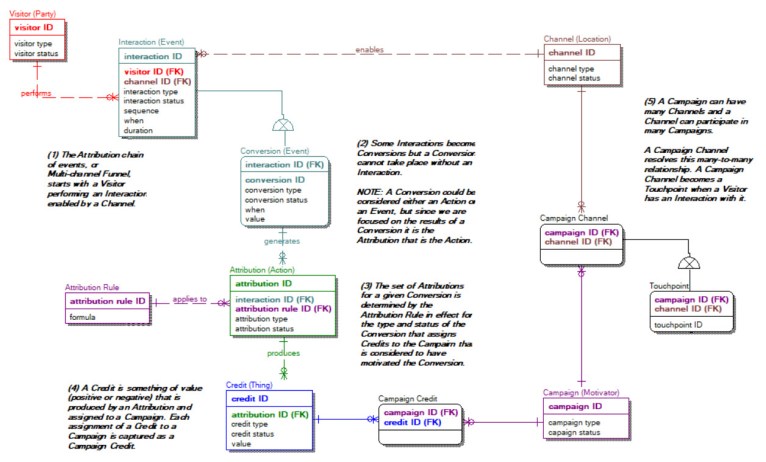 Figure 1.
From a 6BI perspective the Visitor is a type of Party because it represents “who” initiates the sequence of events. Interaction and its sub-type Conversion are types of Events, they identify “when” an action takes place. Credit, a type of Thing, more specifically a Thing of Value to the campaign is “what” the action produces. Attribution, a type of Action, is “how” a credit is produced. The Channel, a type of Location is “where” the events occurred. The assumption as to “why” the visitor interacts and converts is due to the influence of a Campaign, which is a type of Motivator.
The assigning of Campaign Credits to Campaign Channels is identified in Figure 1 by a series of five (5) steps. This process begins with a Visitor performing a type of Interaction, through a Channel, which causes it, the Interaction, to become a Conversion. The Conversion generates Attributions which, based on the application of an Attribution Rule produce Credits which are assigned to a Campaign. The use of a Channel by a Campaign identifies the Touchpoints which ultimately get evaluated based on how much Credit they produce for the Campaign.
To get the net benefit of attribution you need to capture the cost side as well. You need to know and use, in your assessments, not only the costs of applying the attribution rules, but the costs of channels, touchpoints, impressions and campaigns as well. Not only do you need to determine how much influence, for example, your Paid Search feed had in generating conversions when it was the second touchpoint, but the cost of the Paid Search feed service to your enterprise as whole.[v]
The goal of attribution is to determine which touchpoints are producing a positive result, and, by using the cost of each touchpoint, an attribution system can then show which touchpoints are profitable. This allows optimization of marketing expenditures.[vi]
[i] Conversion is a generalized term for the desired result of a marketing effort. This can include other actions besides sales such as sign-ups, survey completions, favorable ratings, etc.
[ii] https://en.wikipedia.org/wiki/Attribution_(marketing)
[iii] https://support.google.com/analytics/answer/
[v] The cost of a touchpoint might vary depending on whether it is first, last or some intermediate (assisting) interaction in the conversion event flow.
 Birkdale Computing